Statement
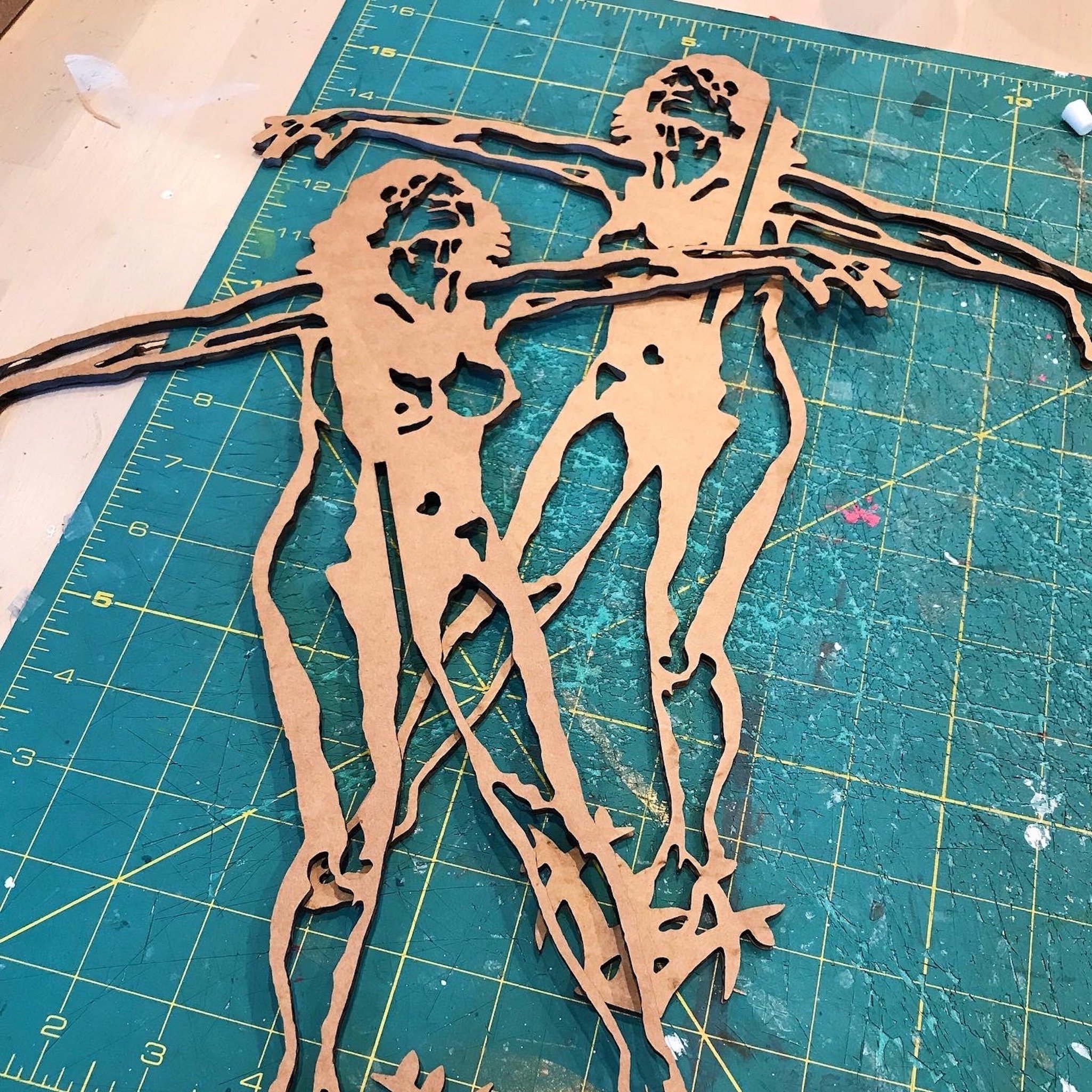
My work emerges at the intersection of body, psyche, and shadow—where the conscious self meets what Jung called "the descent into darkness." Working in graphite, watercolor, and pastels, I create abstract figurative pieces that function as visual inquiries into vulnerability, longing, fear, and transformation. Through layered paper constructions embellished with thread, beads, and pins, I build tactile narratives that honor both the fragility and fierce resilience of embodied experience.
The skeleton appears repeatedly in my practice—not as symbol of death, but as revelation of our shared architecture. Stripped of gender and race, bones speak a universal language of structure and absence, utility and mystery. I keep a skeleton in my studio as daily companion, drawing it through blind contour, rendering it in watercolor washes over precise graphite lines. This practice of mark-making becomes my pathway home to the essential, forgotten self—a methodology informed by my ongoing studies in Gestalt Awareness Practice, somatic movement work with Zuza Engler, and my architectural training, which brings attention to underlying design even within abstraction.
My collections—Paper Narratives, Burning Man, and Feral Grace—position my work within a larger conversation about how contemporary artists use the body to explore archetypal and psychological terrain. Like artists working with Jungian shadow integration, I employ dreams as thresholds where the unconscious offers itself to consciousness. My process aligns with the feminist reclamation of vulnerability and bodily experience as sites of knowledge rather than weakness, contributing to dialogues established by body-centered artists who challenge restrictive ideals through fragmentation, layering, and the revelation of interior states. In an art landscape increasingly concerned with plurality, ambiguity, and the blurred boundaries between destruction and liberation, my abstracted figurative forms refuse easy categorization—existing between presence and absence, the known and the unknowable.
As an "imaginal storyteller, witness, reporting from the inside," I believe each piece remains incomplete until it enters into dialogue with you, the viewer. My work exists as invocation and invitation—a space where your perspective reveals stories only you can tell, where my vulnerability meets yours, where archetypal symbols spark personal resonance. Louise Bourgeois understood this when she wrote that her art functioned as a form of restoration, transforming fragmented experiences into wholeness. Through this exchange—where questions beget questions, where shadows find form, where memory is given a body—we both hear our stories more clearly.